

 Souvik Saha
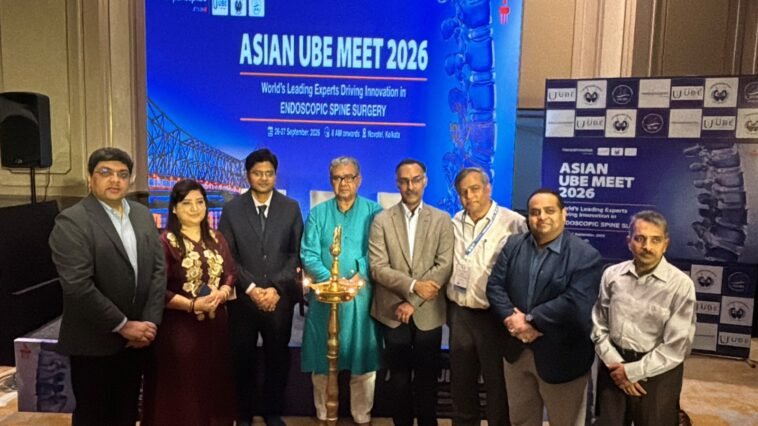
Leading spine surgeons from India and around the world gathered in Kolkata for Asian UBE Meet 2026, a two-day academic meeting focused on the evolving role of Unilateral Biportal Endoscopic Spine Surgery in minimally invasive spine care.
Leading spine surgeons from India and across the world came together in Kolkata for Asian UBE Meet 2026, a two-day academic meeting centred on the evolving applications of Unilateral Biportal Endoscopic Spine Surgery (UBE).
Organised by Manipal Hospitals Kolkata with academic support from the World UBE Society, the meeting brought together international and national experts for scientific discussions, case-based learning and exchange of clinical experience in advanced endoscopic spine surgery.
The event was attended by Shri Sharadwat Mukhopadhyay, Hon’ble Minister of Health & Family Welfare, Government of West Bengal, whose presence highlighted the importance of specialised and minimally invasive healthcare in the region.
Experts Discuss the Future of UBE Spine Surgery
Unilateral Biportal Endoscopic Spine Surgery is an evolving minimally invasive technique that uses two small portals to access the spine while allowing surgeons to perform a range of procedures.
As the adoption of endoscopic approaches continues to develop, the meeting focused on the importance of appropriate patient selection, surgical planning, technical considerations, clinical outcomes and complication management.
Academic Programme Included Case-Based Learning
The scientific programme featured expert lectures, interactive panel discussions, case-based sessions and surgical learning. Participants discussed evolving techniques, challenging cases and decision-making across different clinical settings.
The programme also created an opportunity for specialists from different healthcare systems to exchange practical experiences and perspectives on the use of endoscopic spine surgery.
International and National Faculty Participate
The meeting featured spine surgeons and experts from several countries, alongside specialists from across India.
Portugal
United Kingdom
Malaysia
Bahrain
Pune, India
India & International
Minister Highlights Importance of Knowledge Exchange
Speaking at the event, Shri Sharadwat Mukhopadhyay emphasised the value of conferences that bring healthcare professionals together to share experiences and knowledge.
“Such meaningful collaboration not only strengthens clinical practice but also contributes to the continuous evolution of healthcare, with a shared focus on delivering better outcomes and more patient-centred care.”
Dr Anindya Basu on Minimally Invasive Spine Care
Dr Anindya Basu, Organising Chairman of Asian UBE Meet 2026 and Clinical Lead & Senior Consultant, Spine Surgery, Manipal Hospitals Mukundapur, said the meeting provided a platform to critically examine surgical techniques, patient selection, challenging cases and clinical outcomes.
He noted that endoscopic spine surgery is expanding the scope of minimally invasive care and said academic exchanges are important for strengthening evidence-based practice and supporting the safe and appropriate adoption of these techniques.
Manipal Hospitals Highlights Academic Collaboration
Dr S Vidyadhara, Chairman and HOD for Spine Surgery, Consultant for Robotic Spine Surgery, and Co-Chairman of the Medical Advisory Board at Manipal Hospitals, Old Airport Road, Bengaluru, also highlighted the importance of international knowledge exchange.
He said platforms such as the Asian UBE Meet reflect Manipal Hospitals’ focus on education, academics and clinical excellence, while describing UBE as an important development within minimally invasive spine surgery.
Meeting Concludes with Complex Case Discussions
The meeting concluded with interactive discussions around complex spine conditions, giving participating surgeons an opportunity to examine surgical planning, technique selection and decision-making in challenging cases.
By bringing together specialists from India and overseas, Asian UBE Meet 2026 highlighted the role of continuous medical education, collaboration and knowledge-sharing in the development of minimally invasive spine surgery.